In a tale that blends nostalgia, adventure, and mechanical prowess, Lloyd Dahmen recounts his remarkable journey through the renowned Peking to Paris Rally in his 1949 Cadillac Coupe. This iconic vehicle, a symbol of post-war American engineering, served as Dahmen's trusty steed through rugged terrain, diverse landscapes, and the winds of history.
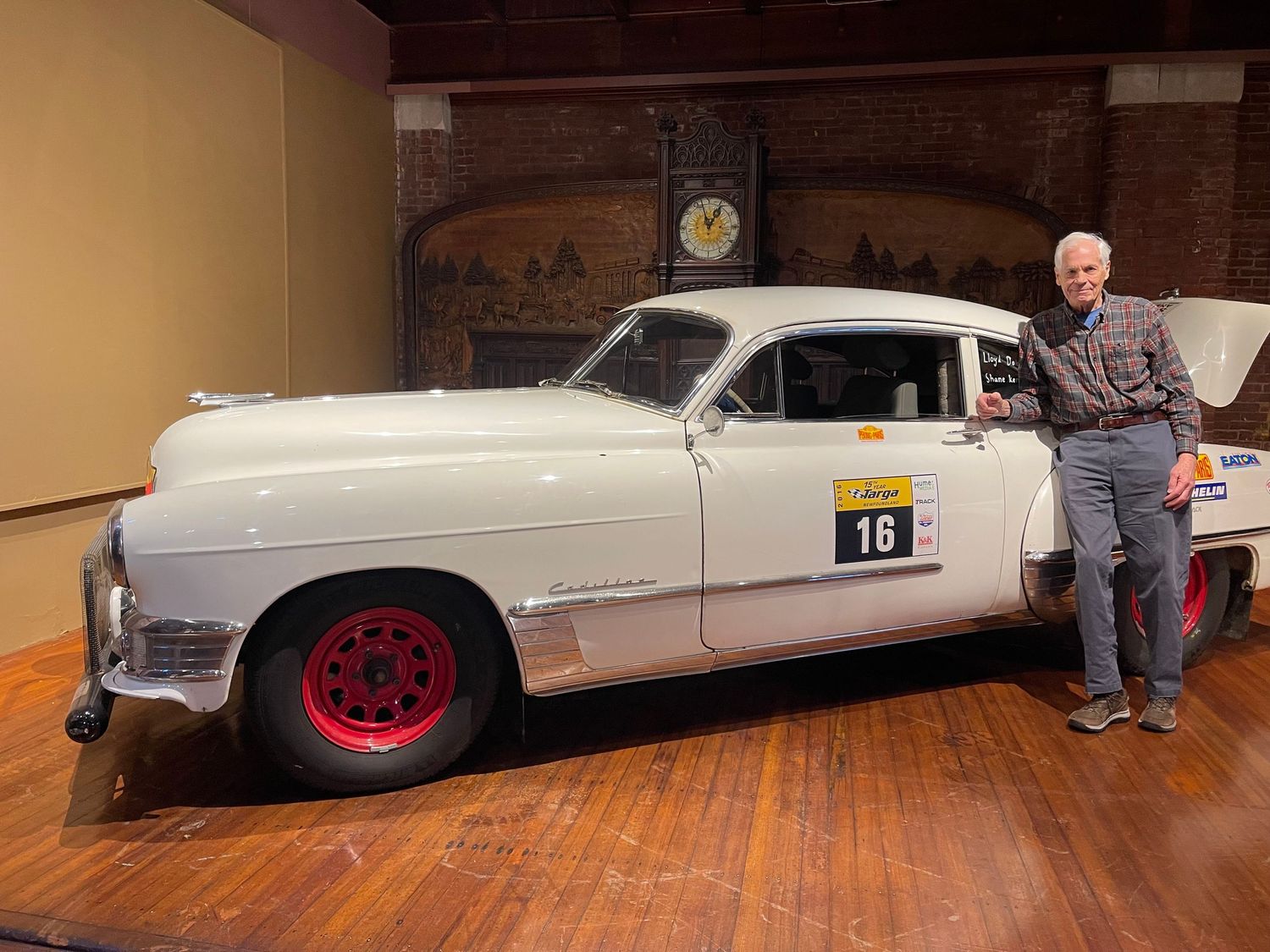
The conversation began with the Cadillac itself—a 1949 model, the epitome of automotive elegance in its era. Dahmen elucidates its unique characteristics, detailing the tail fins, a styling staple of the post-World War II era. It is referred to as a sedanette, although Cadillac never officially called it that. Instead, they referred to it as a club coupe. He goes on to explain that only 3% of this model was manufactured as manual transmissions, but this one is an automatic; for a very specific reason. As he reminisces about its distinctive styling and enduring appeal, it becomes evident that this car is more than just a mode of transportation; it's a piece of history brought to life on the rally stage. The Peking to Paris Rally is a 37-day, 14,000 km rally, traversing through 9 countries, including China, Mongolia, Russia, the Stans, Iran, Turkey, Greece, Italy and France.
So why choose a piece of American steel? Dahmen's decision was deliberate—he sought to inject a dash of American flair into a competition dominated by European classics. “The 49 Cadillac has some real advantages as a rally car,” states Dahmen. He also simply liked the style of Cadillac. He recalls the car being very popular when he was a young 10-year-old boy. Many years later, they kept popping up and he still thought they were the coolest-looking cars. “It was a very stout car. It was going to survive whatever was going to be thrown at it.”
He believed in the Cadillac's resilience and durability, qualities that would prove indispensable on the challenging roads ahead. He describes that the muffler of the car is not hanging down and is flush with the undercarriage, unlike most other vehicle designs, leaving a smooth underside. “Mufflers get dragged off,” Dahmen continues, which is a common problem during long endurance rallies on all types of terrain.
As Dahmen delves into the preparations for the rally, he reveals the meticulous attention to detail that went into optimizing the Cadillac for the grueling journey. He spent several years preparing the Cadillac. The first year, he focussed on the engine. He originally wanted a manual transmission, but the more he thought about it, an automatic would make more sense in his opinion. General Motors built a Hydramatic Transmission, which was an incredible piece of engineering at the time. This transmission was similar to what was used in light tanks during World War 2, meaning it could handle all abuse on the road. Peking to Paris is not a race about speed, but control. The hydramatic transmission had a lot of advantages in this case.
Dahmen stiffened up the shocks and raised the car about an inch and a half for just a bit more ground clearance. For those first several months Dahmen simply drove the car to see what was wrong with it, and what could be improved. He eventually added skid plates that start from right under the front bumper and go all the way down to the rear of the car so that everything was protected. Next came the fuel system. The organizers of the rally indicated that you needed a range of 400 miles, and with an average 20-gallon tank and 15 mpg, something needed to change. Dahmen recalls crossing over the border and getting almost 16mpg before reaching the next gas station, which ended up being closed. He found that about 35-40mph was the optimal speed to get the best gas mileage. “You want to figure out what your optimal glide path is and just stay on it,” says Dahmen. To help with the range, a second gas tank was added. If one tank went bad or ran out of gas, you had to be able to switch quickly. To do this, Dahmen added a switch to easily go between the two tanks when needed.
Another important item was a measuring device for distance traveled. The one Dahmen installed in his Cadillac was simple and would measure the distance from one lug nut to the next, so that each time the tire rotated, he knew precisely how far he had traveled and consequently how far he still needed to go.
Dahmen’s Cadillac performed superbly when the time came. He had only one issue about a ⅓ of the way through the rally, in the middle of the Gobi Dessert. He recalled feeling some looseness in the steering column. He pulled over immediately and inspected the car to discover that a nut had come off the pin that attached the vertical front suspension. Had that gone unnoticed, it could have meant the end of the journey. The arm would have moved downward because of the spring, and it would have been impossible to get it back into place without the proper equipment. Dahmen knew his car so well from years of preparation and driving that he knew the moment something felt wrong. Luckily, the correctly threaded nut was in the box of spare parts he had with him.
So how do you navigate through the middle of the Gobi Desert? Each participant is given what is referred to as a route book. The book includes the route and specific symbols that, for example, tell you what turn you should make and in what direction you will want to turn. It also indicates the specific speed that you should be going. Dahmen recalls in the Gobi Desert, that there were often more than one set of tracks, which would happen because big trucks would come through. Some tracks would veer off and just go toward the next town. Dahmen stated that having a good navigator is also key for these rallies. A navigator must be precise and clear when giving directions. A navigator cannot point and say, “Go that way!” as Dahmen gestured with his hands. A driver’s job is to keep their eyes on the road and listen to the navigator's directions.
What was a lesson that one can take away from this kind of experience? Dahmen states that he learned to drive and concentrate on the road. Being able to focus on the road surface and its conditions ahead is vital to the survival of the car. “It is crucial if you want to survive in these rallies,” Dahmen states, referring to the preparations he made for the rally. Of the 100 cars that started the Peking to Paris endurance rally, only 50 finished.
We asked Dahmen what the most memorable thing he took away from the whole experience was. He recalls going through the Gobi Desert, and aside from the views, were hardworking and good people. “How resourceful they are,” recounts Dahmen. The people of the Gobi Desert are incredibly self-reliant, and “super horse people.” They can ride for hours to get where they need to go and get done what they need to. Dahment goes on to state that they are a peaceful people. The people that Dahmen met along the way were just as important, if not more than the journey itself. Dahmen made lifelong friends that he still speaks with today and continues to see.
In the end, Dahmen's journey in the 1949 Cadillac Coupe transcends mere competition—it's a celebration of adventure, resilience, and the timeless allure of classic automobiles. And as his Cadillac crossed the finish line, it's not just a victory for Dahmen—it's a triumph for the spirit of adventure that lives on in all who dare to dream.
Enter a Heading
This is a paragraph. Click edit and enter your own text. You can make changes like making the text bold, underline or italic. This is a great place for you to tell your clients more about your story and to describe the type of photographer you are. You can come back at any time to make more changes.